
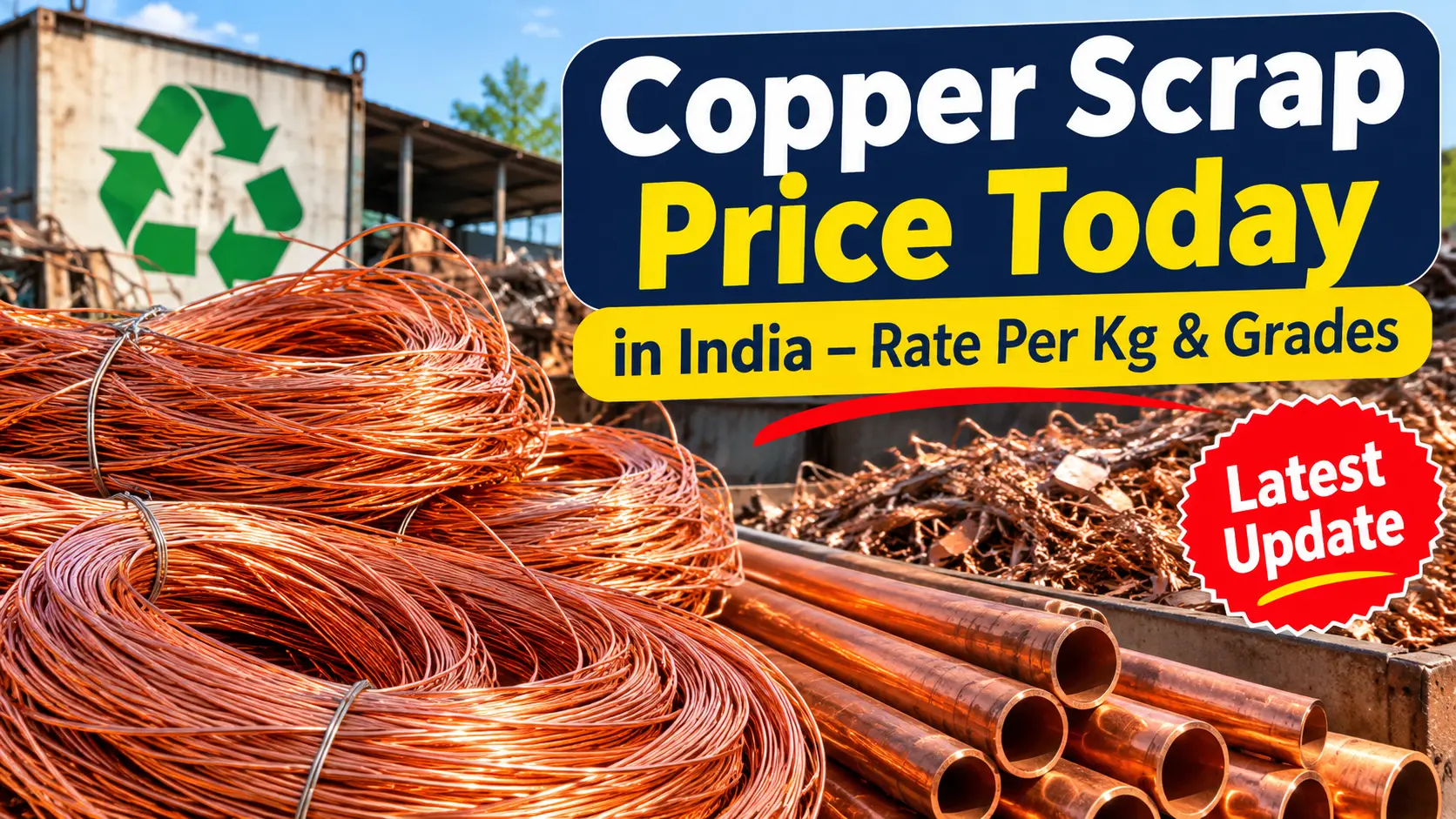
The copper scrap price today in India depends on the type, quality, purity and recoverable copper content of the material. Clean copper wire, old copper pipes, motor winding, insulated cables and mixed copper scrap do not have the same market value. Scrap dealers assess each material according to its condition, grade, weight and processing requirements before offering a price per kilogram.
Copper scrap is widely collected from electrical wiring, plumbing systems, industrial machinery, motors and manufacturing waste. Since copper can be recovered and reused, it has an established recycling market across India.
If you are planning to sell copper scrap or simply want to understand its market value, this guide explains the different copper scrap grades, local market terminology, price calculation methods and the factors that influence the rate.
Copper Scrap Price Per Kg in India
There is no single fixed copper scrap price per kg for the entire Indian market. The amount offered by a buyer can vary according to the scrap grade, copper content, contamination, quantity and location.
For example, clean bare copper wire is different from insulated electrical cable. Similarly, copper pipes containing brass fittings or solder may receive a different quotation from clean copper tubing.
Before comparing prices, identify the material you have and ask the buyer to quote for that specific grade.
Important: Copper scrap buying rates are indicative market quotations, not guaranteed selling prices. Confirm the current rate with a local scrap dealer before making a transaction.
For broader copper market information, visit AajBazar's Copper Rate Today in India page.
Copper Scrap Grades and Their Differences
Copper scrap is classified according to its physical condition, composition and the amount of processing required before recycling. International scrap specifications provide useful descriptions of several commonly recognised copper categories.
The following table explains the major categories in simple terms.
| Copper scrap grade | General description |
|---|---|
| Bare Bright Copper | Clean, bright, bare copper wire without coating or insulation |
| No. 1 Copper Wire | Clean, uncoated and unalloyed copper wire and cable |
| No. 2 Copper Wire | Mixed unalloyed copper wire with some permitted impurities |
| No. 1 Heavy Copper | Clean copper solids, clippings, busbars and tubing |
| No. 2 Copper Solids | Mixed copper solids and tubing with lower-grade characteristics |
| Insulated Copper Cable | Copper wire covered with plastic or rubber insulation |
| Motor Winding Scrap | Copper winding recovered from motors and electrical equipment |
Actual buyer specifications may differ. A grade name should always be confirmed with the buyer before accepting a quotation.
1. Bare Bright Copper Scrap
Bare bright copper is generally one of the most desirable copper wire scrap categories. It consists of clean, bright, uncoated and unalloyed copper wire without insulation.
It should be free from significant contamination, tin coating, solder and burnt or brittle wire.
Because this material requires relatively little additional preparation, it can attract a better quotation than many mixed or insulated copper materials.
2. No. 1 Copper Scrap
No. 1 copper includes clean, unalloyed copper wire, cable and certain heavy copper materials that meet the applicable buyer specification.
Examples include clean copper wire, busbars, clippings and suitable copper tubing.
The material should be properly sorted and free from excessive contamination, solder, attached non-copper components and other excluded materials.
3. No. 2 Copper Scrap
No. 2 copper is a lower-grade category of unalloyed copper scrap. It can include miscellaneous copper wire or solid copper materials that do not meet the stricter No. 1 specifications.
Oxidation, solder, tinning or other permitted impurities may affect its classification.
Some recognised specifications describe No. 2 copper as having a nominal copper content of approximately 96%, with a minimum of 94% determined by assay. The actual specification depends on the material category and applicable grading rules.
4. Copper Wire Scrap
Copper wire scrap is recovered from electrical installations, old cables, industrial wiring and discarded electrical equipment.
Its value depends mainly on whether the copper is separated from the insulation.
Clean, stripped wire and insulated cable should not be treated as the same product. Insulated wire requires additional processing to recover the copper.
5. Copper Pipe Scrap
Copper pipes are commonly recovered from plumbing systems, air conditioners, refrigeration units and industrial installations.
Clean copper pipes may qualify for a higher-grade category. However, pipes containing brass fittings, solder, steel attachments, insulation or other materials may be downgraded.
Sorting the pipes and identifying attached components can help buyers assess their actual recoverable value.
6. Motor Winding and Armature Scrap
Electric motors, generators and transformers contain copper winding used to conduct electricity.
During dismantling, the recovered material may include enamel-coated wire, varnish, steel components and other attachments.
The final quotation depends on the amount of copper that can actually be recovered. Motor winding and complete motor armatures should therefore be evaluated separately.
7. Insulated Copper Cable Scrap
Insulated copper cable contains a copper conductor covered with PVC, rubber or another insulating material.
Its total weight includes both copper and insulation. Buyers commonly evaluate this material according to its copper recovery potential rather than treating the entire cable weight as pure copper.
Cable type, conductor thickness, insulation material and metal content all affect the quotation.
Indian Copper Scrap Market: Local Names and Grade Identification
Indian scrap dealers may use local commercial names rather than formal international grade classifications.
Names such as Laal Maal, Telewire, AC Jali Pipe, Armature, Mota, Medium, Bareek Saaf and Kalaiyya may appear in different market quotations.
However, these names do not always have one universally accepted technical definition. Their meaning can vary between dealers, cities and trading markets.
For this reason, do not assume that a local trade name is automatically equivalent to Bare Bright, No. 1 or No. 2 copper.
When checking a scrap quotation, ask the dealer:
- What material does the grade include?
- Is it clean copper or mixed material?
- Does it contain insulation, solder or other metals?
- Is the quotation based on gross weight or recoverable copper?
- Are any deductions applied after inspection?
This makes price comparisons more reliable.
What Factors Affect Copper Scrap Price Today?
Several factors influence the copper scrap rate offered by recycling dealers.
Copper Content and Purity
Materials with higher recoverable copper content generally have a higher value. Plastic, rubber, steel, brass, solder, paint and other unwanted materials can reduce the recoverable metal content.
Scrap Grade and Condition
Clean bare wire, heavy copper solids, insulated cables and motor winding have different processing requirements. Their prices therefore vary.
International Copper Market
Copper is traded in international commodity markets. Changes in global supply, industrial demand, benchmark prices and currency exchange rates can influence domestic copper valuations.
However, local scrap buying prices do not necessarily move by the same percentage as refined copper prices.
Local Market Demand
Recycling capacity, industrial demand, dealer competition and available scrap supply can create price differences between Indian cities.
Quantity and Transportation
A large, properly sorted industrial lot may receive a different commercial quotation from a small mixed household lot. Collection costs and transportation arrangements may also affect the final amount.
How to Calculate Copper Scrap Value
You can estimate the value of copper scrap using a simple calculation.
Estimated Scrap Value = Scrap Weight × Quoted Price Per Kg
For example, assume a buyer offers ₹700 per kg for a particular grade.
| Scrap weight | Estimated value |
|---|---|
| 1 kg | ₹700 |
| 5 kg | ₹3,500 |
| 10 kg | ₹7,000 |
| 20 kg | ₹14,000 |
These are mathematical examples only, not verified current market prices.
For insulated cables or mixed scrap, the buyer may calculate the price using recoverable copper weight instead of total material weight.
For example, if 10 kg of cable produces 6 kg of recoverable copper, the buyer may base the valuation on the recovered metal and apply the relevant processing costs.
Copper Scrap Price Differences Across Indian Cities
Copper scrap rates can differ between cities because local markets do not operate under one uniform buying price.
Delhi, Mumbai, Kolkata, Chennai, Bengaluru, Hyderabad, Pune and Ahmedabad may have different dealer networks, transportation costs and recycling demand.
Even within the same city, two scrap buyers may offer different quotations for the same material.
For an accurate comparison:
- Identify the exact copper scrap grade.
- Ask for the price per kilogram.
- Compare quotations from multiple buyers.
- Confirm transportation and handling deductions.
- Check the final weight and payment terms.
A national indicative price should not be interpreted as a guaranteed local selling price.
Refined Copper Price vs Copper Scrap Price
Refined copper and copper scrap are different products.
Refined copper is processed metal with specified quality and composition. It is used in electrical wires, rods, sheets, industrial components and manufacturing.
Copper scrap consists of recovered copper-bearing materials that may require sorting, cleaning, stripping or further processing.
| Comparison | Refined copper | Copper scrap |
|---|---|---|
| Material | Processed copper | Recovered copper material |
| Quality | Specified composition | Varies by grade |
| Processing | Already refined | May require processing |
| Pricing basis | Commodity and product specifications | Grade and recovery value |
| Market use | Manufacturing | Recycling and metal recovery |
Therefore, the refined copper market price per kg should not be considered the exact buying or selling price of copper scrap.
How to Get a Better Price When Selling Copper Scrap
Before selling copper scrap, follow a few practical steps.
- Separate different materials: Keep clean copper wire, pipes, motor winding and insulated cables in separate groups.
- Identify the grade: Ask the buyer to explain the grade and material specifications.
- Avoid unnecessary mixing: Brass, steel, plastic and other materials can affect the quotation.
- Compare local quotations: Obtain offers from more than one scrap dealer.
- Check the weighing process: Confirm the weight using a reliable weighing scale.
- Understand deductions: Ask whether transportation, moisture, insulation or processing costs will be deducted.
Never burn insulated wires to remove their plastic covering. Burning cable insulation can release harmful fumes. Use appropriate mechanical stripping equipment or professional recycling services instead.
Frequently Asked Questions About Copper Scrap Price
1. What is the copper scrap price today in India?
The copper scrap price today depends on the grade, purity, condition, quantity and location. Clean copper wire, insulated cable, motor winding and mixed scrap can receive different quotations.
2. What is the copper scrap price per kg?
There is no single fixed rate for every copper scrap category. Ask local buyers for a grade-specific quotation per kilogram.
3. Which copper scrap grade has the highest value?
Clean bare bright copper wire is generally a high-value copper scrap category because it has minimal coating and contamination. The actual quotation depends on buyer specifications and market conditions.
4. What is the difference between No. 1 and No. 2 copper?
No. 1 copper generally has stricter cleanliness and material requirements. No. 2 copper permits certain additional impurities or lower-grade characteristics under the applicable specifications.
5. Is insulated copper wire worth selling?
Yes. Insulated copper cable has recycling value because its copper conductor can be recovered. Its quotation depends on the copper content and the cost of processing the insulation.
6. Why do copper scrap prices vary between cities?
Differences in local demand, recycling facilities, transport expenses, supply and dealer competition can cause regional price variations.
7. Is copper scrap price the same as refined copper price?
No. Refined copper and scrap copper are different products. Scrap prices account for material grade, recoverable copper content and processing requirements.
8. How can I calculate the value of copper scrap?
Multiply the accepted scrap weight by the buyer's quoted price per kilogram. For mixed or insulated material, the buyer may first assess the recoverable copper content.
9. Do copper pipes and copper wires have the same scrap value?
Not necessarily. Their condition, cleanliness, attachments and material specifications can differ, resulting in different quotations.
10. Does copper scrap price change every day?
It can change frequently as international copper markets, currency movements, local supply and industrial demand change. Buyers may also revise their quotations according to their own purchasing conditions.
Final Thoughts
Copper scrap is a valuable recyclable material, but its market value depends on the actual material being sold. Clean copper wire, heavy copper solids, insulated cables, pipes and motor winding should be evaluated according to their individual grades and recoverable copper content.
Before accepting an offer, identify the material, compare grade-specific quotations and confirm the final weight and deductions.
For broader copper market updates and copper prices per kilogram, visit AajBazar's Copper Rate Today in India page.
AajBazar aims to help readers understand metal prices, market differences and the factors that influence buying and selling decisions.