
Last Updated: November 16, 2026 | 07:05 PM IST
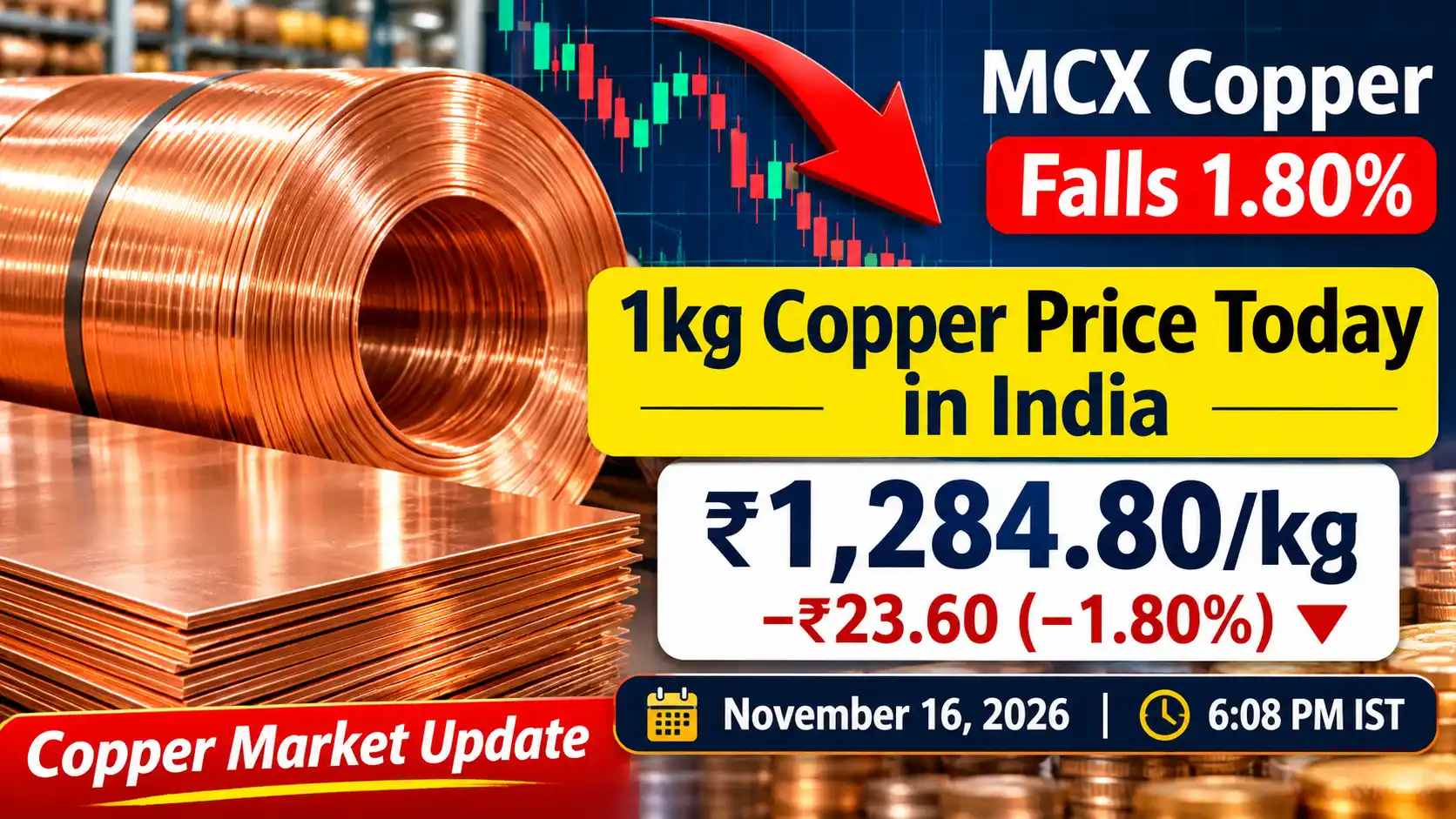
1kg Copper Price Today in India: MCX Copper Falls to ₹1,284.80 per Kg
The 1kg copper price today in India witnessed a sharp decline in the domestic commodity market on November 16, 2026, as MCX copper futures traded lower during the latest trading session.
According to the latest available MCX copper futures market data at 6:08 PM IST, copper futures were trading at ₹1,284.80 per kg, down ₹23.60 or 1.80% from the previous close of ₹1,308.40. The contract opened at ₹1,300.00 and moved between ₹1,281.30 and ₹1,300.85 during the trading session.
The decline indicates selling pressure in the domestic copper futures market. Traders, manufacturers, scrap dealers and industrial buyers are closely monitoring the latest movement to understand its potential impact on copper-related costs.
For consumers searching for the copper 1kg price, it is important to understand that the MCX futures quotation is different from the final price of physical copper, copper utensils, sheets, wires or scrap. Retail prices can vary according to product quality, location, quantity and dealer margins.
Copper Price Today in India – November 16, 2026
The following table summarises the latest available MCX copper market information.
| Market Details | Price / Data |
|---|---|
| Copper futures price | ₹1,284.80/kg |
| Previous close | ₹1,308.40/kg |
| Price change | -₹23.60 |
| Percentage change | -1.80% |
| Opening price | ₹1,300.00/kg |
| Day’s high | ₹1,300.85/kg |
| Day’s low | ₹1,281.30/kg |
| Trading volume | 5,417 |
| Market value | ₹69.60 lakh |
| Contract expiry | November 30, 2026 |
| Market | MCX |
| Latest reference time | November 16, 2026, 06:08 PM IST |
Note: These figures represent the MCX futures market snapshot shown above, not a guaranteed physical copper selling or buying rate. Prices may change during market hours.
1kg Copper Price Today: What Is the Latest Market Trend?
Copper futures experienced a downward movement in the latest available market data. The contract was trading at ₹1,284.80 per kilogram, compared with its previous close of ₹1,308.40.
The difference of ₹23.60 per kg represents a decline of approximately 1.80%.
The contract opened at ₹1,300.00, indicating that trading began below the previous closing price. During the reported session, the price moved within a range of ₹1,281.30 to ₹1,300.85.
This trading range provides an indication of the market’s recent price movement. The inability to maintain the previous closing level reflects selling pressure during the reported session.
However, a single session’s decline does not necessarily establish a long-term downward trend. Copper prices can change quickly depending on international market developments, industrial demand and speculative trading activity.
For businesses that regularly purchase copper, monitoring both domestic futures and physical market quotations is important before making purchasing decisions.
Copper 1kg Price: How Much Does 100 Gram Copper Cost?
People searching for the 100 gram copper price often want to understand the approximate cost of smaller quantities.
Using the latest available MCX futures reference of ₹1,284.80 per kg, the simple mathematical equivalent is:
| Copper Quantity | Indicative MCX Equivalent |
|---|---|
| 1 kg | ₹1,284.80 |
| 500 grams | ₹642.40 |
| 250 grams | ₹321.20 |
| 100 grams | ₹128.48 |
| 50 grams | ₹64.24 |
| 10 grams | ₹12.85 |
These figures are mathematical conversions of the futures quotation. They are not confirmed retail prices for physical copper.
The actual price of 100 grams of copper can be higher or lower depending on the product being purchased. Copper wire, copper sheets, utensils, electrical components and copper scrap do not necessarily carry the same per-kilogram rate.
Retail sellers may also include processing costs, manufacturing expenses, transportation charges and applicable taxes.
Therefore, consumers should check the seller’s quotation before treating the calculated amount as the final purchase price.
1 Kg Copper Price in Delhi: What Should Buyers Know?
The 1 kg copper price in Delhi may differ from the reference rate shown on the MCX because physical copper prices are influenced by local wholesale and retail market conditions.
Delhi buyers may purchase copper through metal wholesalers, electrical material suppliers, utensil shops, industrial distributors and scrap dealers.
Each category can quote a different price depending on the material’s form and quality.
For example:
- Pure copper sheets may have a different price from copper wire.
- Insulated electrical cables cannot be valued in the same way as clean copper metal.
- Mixed copper scrap may receive a different quotation from sorted and clean copper scrap.
- Finished copper utensils include manufacturing and finishing expenses.
Consequently, there is no single universal retail rate for every type of copper sold in Delhi.
Anyone comparing the 1 kg copper price in Delhi should confirm the product specification, material quality, quantity and whether the quotation includes taxes and delivery charges.
For accurate purchasing decisions, compare quotations from multiple local suppliers rather than relying entirely on a futures-market price.
Why Are Copper Prices Moving in India?
Copper is an important industrial metal used across construction, manufacturing, electricity distribution, transportation and infrastructure development.
Its market price is influenced by several interconnected factors.
1. Global Copper Demand
Industrial demand plays a major role in determining copper prices. The metal is widely used in electrical cables, power infrastructure, machinery, construction materials and manufacturing equipment.
Demand from countries with large industrial sectors can influence international copper prices. China is particularly important because of its substantial role in manufacturing and industrial consumption.
When demand improves, market participants may anticipate higher copper consumption. Conversely, weaker industrial activity can create pressure on prices.
2. Supply and Mining Conditions
Copper production depends on mining operations, processing capacity, transportation and the availability of raw materials.
Disruptions at major mines, production delays or logistical difficulties can affect the supply of refined copper.
When supply becomes tight while demand remains firm, prices may receive upward support.
However, an increase in production or the release of additional inventories can reduce supply concerns.
3. Electric Vehicles and Renewable Energy
Copper is an essential material in electric vehicles, charging infrastructure, solar power systems, wind energy projects and electricity networks.
The expansion of these industries creates long-term demand opportunities for copper.
However, actual price movements also depend on the pace of project development, manufacturing activity and the availability of alternative materials.
4. US Dollar and International Commodity Markets
Copper is internationally traded, with major benchmarks quoted in US dollars.
Changes in the dollar’s value can influence commodity prices and the cost of importing copper into India.
Currency fluctuations may therefore affect domestic copper market quotations even when international prices remain relatively stable.
5. Investor Positioning and Futures Trading
MCX copper futures are influenced by buying and selling activity from market participants.
Changes in open interest, trading volume and investor positioning can provide additional information about market sentiment.
A price decline accompanied by changes in open interest may reflect a shift in futures-market positions. However, these indicators should be interpreted together rather than used independently to predict future prices.
Global Copper Market: Demand and Supply Remain Important
International copper developments continue to influence the domestic market.
Global industrial demand, mining production, inventory conditions and investment activity are among the important factors affecting copper quotations.
Changes in the distribution of copper stocks across major exchanges can also influence market sentiment.
This creates a market environment in which prices may react to both financial-market sentiment and physical demand.
For Indian buyers, international developments matter because imported copper, domestic industrial demand, currency movements and exchange quotations all contribute to the broader pricing environment.
The latest negative MCX movement should therefore be viewed in the context of the wider international market rather than as an isolated event.
Will Copper Prices Increase Further?
It is difficult to predict the exact direction of copper prices.
The latest available MCX snapshot shows a decline of 1.80%, but one trading session is not enough to establish a long-term trend.
Several developments may influence the next price movement:
- Changes in international copper prices.
- Industrial demand from China and other major economies.
- Global copper mine production and inventory levels.
- Changes in the Indian rupee against the US dollar.
- Trading volume and open-interest movements on MCX.
- Demand from electrical, construction and manufacturing industries.
If demand strengthens while supply remains constrained, copper may receive further support.
On the other hand, weaker industrial consumption, increased supply or stronger selling activity could put additional pressure on prices.
Buyers should monitor updated market quotations instead of assuming that the latest decline will continue.
Difference Between MCX Copper Price and Physical Copper Price
One important point for consumers is that the MCX copper futures rate and the physical copper market rate are not identical.
MCX prices refer to exchange-traded futures contracts. Physical copper is bought and sold through wholesalers, manufacturers, distributors and local dealers.
The final physical price may depend on:
- Copper purity and material specification.
- Whether the product is a sheet, wire, rod, utensil or scrap.
- Wholesale or retail purchasing quantity.
- Transportation and handling expenses.
- Local demand and supply conditions.
- Taxes and applicable dealer charges.
For this reason, someone searching for the copper price per kg should identify whether they need a futures quotation, a wholesale metal quotation or a retail purchase price.
This distinction is especially important when comparing prices between different Indian cities.
What Should Copper Buyers and Scrap Dealers Watch?
Copper buyers should pay attention to more than just the headline market price.
For manufacturers and electrical businesses, the cost of raw materials can influence production expenses and profit margins. Regular monitoring of copper prices can help businesses evaluate purchasing requirements.
Scrap dealers should separately examine the grade and recoverable copper content of the material. Clean copper scrap, mixed scrap and insulated wire can receive different quotations.
Households purchasing copper utensils should compare the weight, product quality, manufacturing charges and seller’s final quotation.
A reliable purchasing decision should be based on the actual product and its market category, not simply on an exchange-traded futures rate.
Conclusion: Copper 1kg Price Today in India
The latest available MCX market snapshot for November 16, 2026, showed copper futures trading at ₹1,284.80 per kg, representing a decline of 1.80% from the previous close of ₹1,308.40.
The contract recorded an opening price of ₹1,300.00 and a reported trading range of ₹1,281.30 to ₹1,300.85.
The movement provides an updated reference for people tracking the 1kg copper price today, but it should not be treated as a confirmed retail or scrap quotation.
Consumers looking for the 1 kg copper price in Delhi or the 100 gram copper price should verify local physical-market rates according to product quality, quantity and dealer charges.
AajBazar will continue tracking copper market developments and publishing updates to help readers understand daily price movements in India.
Frequently Asked Questions (FAQs)
1. What is the 1kg copper price today in India?
The latest available MCX reference on November 16, 2026, showed copper futures at ₹1,284.80 per kg. Physical copper prices may differ depending on quality, location and seller.
2. What is the copper 1kg price in India?
The copper 1kg price depends on whether you are checking MCX futures, physical copper, copper products or scrap. These markets can have different quotations.
3. What is the 1 kg copper price in Delhi today?
A separately verified Delhi retail quotation is not available in this market snapshot. Buyers should check local wholesalers and suppliers for the latest physical copper price.
4. What is the 100 gram copper price today?
The mathematical equivalent of ₹1,284.80 per kg is ₹128.48 for 100 grams. This is based on the MCX futures reference and is not a confirmed retail selling price.
5. What is the copper price per kg on MCX?
The latest available MCX reference was ₹1,284.80 per kg on November 16, 2026, at 6:08 PM IST.
6. Why does copper price change every day?
Copper prices change because of international demand, mining supply, industrial consumption, currency movements, inventory levels and futures-market trading activity.
7. Is the MCX copper rate the same as the copper scrap price?
No. Copper scrap prices depend on material grade, cleanliness, copper recovery, local demand and dealer conditions. MCX futures should not be used as a direct scrap-buying quotation.
8. Where can I check the latest copper rate in India?
Readers can follow AajBazar’s Copper Rate Today page for copper market updates and reference information.